Trade Secret Protective Orders in Taiwan: Key Differences from U.S. Federal Practice
Author: Jamie J. Yang, Partner
Foreign companies litigating in Taiwan, or managing parallel proceedings across both jurisdictions, frequently bring assumptions shaped by U.S. federal practice. Those assumptions can be costly. Taiwan’s mechanism for protecting trade secrets in litigation operates under a fundamentally different logic, with a statutory constraint that has no direct U.S. equivalent and limited room for judicial flexibility. Understanding the divergence before documents enter the record is essential.
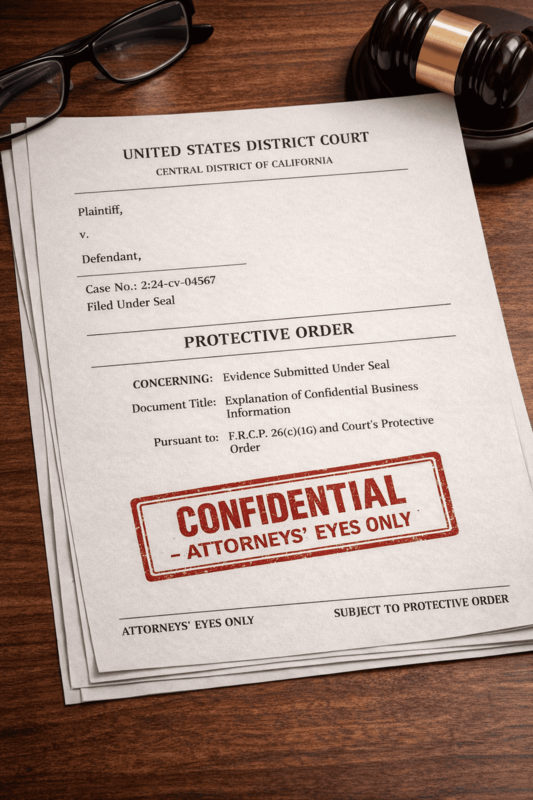
Photo by ChatGPT
The U.S. Baseline: FRCP 26(c)
Under the Federal Rules of Civil Procedure, the protective order framework is built for high-volume, compelled disclosure. U.S. federal discovery is expansive, parties must produce broadly relevant materials, often in massive volumes under tight timelines. Inadvertent disclosure can be an almost inevitable byproduct of this system, and the law accommodates it accordingly.
FRCP 26(c) gives courts broad discretion to issue protective orders on a good cause showing, covering trade secrets and other confidential commercial information. Courts may craft tiered designations, typically “Confidential” and “Attorneys’ Eyes Only”, and may modify orders as the case develops. Where a party inadvertently produces privileged or work-product material, FRCP 26(b)(5)(B) provides a clawback procedure, and FRE 502 limits waiver consequences where reasonable precautions were taken.
Critically, this architecture is a response to the structural reality of U.S. discovery: when disclosure is compelled at scale, the system builds in relief valves. Judicial discretion under Rule 26(c) is the mechanism through which courts calibrate protection to actual circumstances.
Taiwan’s Framework: The IP Case Adjudication Act
Taiwan is a civil law jurisdiction with no discovery. Without a direct order from the court, nothing enters the litigation record involuntarily, parties submit what they choose to submit, when they choose to submit it. That structural difference underlies everything that follows.
Under Article 11 of the IP Case Adjudication Act (pre-2023 amendment; Article 36 under the current version), a court may issue a protective order — known in Taiwan as a “秘密保持命令” — upon a showing that: (1) briefs or evidence in the proceeding contain trade secrets; and (2) disclosure or use outside the litigation would harm the trade secret holder’s business activities.
The mechanism works by binding the recipient: a party subject to a protective order may not use the protected material for purposes outside the litigation, nor disclose it to persons not covered by the order. Violation carries criminal penalties.
The Channel Restriction: Taiwan’s Hard Statutory Limit
Here is where the two systems diverge most sharply. Taiwan’s protective order mechanism contains a critical eligibility restriction with no U.S. counterpart: the order can only bind a party who obtained the trade secret through case scroll viewing or court evidence investigation. If the opposing party obtained the material through any other means before the order was sought, the mechanism simply does not apply to them.
This is not a matter of judicial discretion or order drafting, rather, it is a statutory floor that courts cannot waive. The 2020 Micron case (109 年度刑秘聲字第 12 號) illustrates the successful use of the mechanism: the petitioner had secured protective orders at the trial court level before the opposing counsel accessed the materials through the case record, and the appellate court extended coverage on that basis.
The 2025 case (114 年度民秘聲上字第 15 號) illustrates the failure mode. The applicant submitted documents containing alleged trade secrets as attachments to a court brief, without redaction and without a protective order already in place. The court found two independent grounds for denial: first, the opposing parties had already received the materials through the brief, falling outside the scroll-viewing channel; second, the unredacted voluntary submission itself undermined the “reasonable measures” prong of the trade secret definition under Article 2 of the Trade Secrets Act.
The Practical Comparison
| | FRCP 26(c) | Taiwan Art. 11 / Art. 36 |
|—|—|—|
| System context | Compelled, high-volume discovery | No discovery; voluntary submission only |
| Coverage trigger | Confidential material in discovery | Material obtained through scroll viewing or evidence investigation only |
| Inadvertent disclosure | Clawback mechanisms available; courts retain flexibility | Voluntary unredacted submission may destroy trade secret status and foreclose the mechanism |
| Timing of application | Flexible; courts can modify orders as case evolves | Must precede opposing party’s acquisition of the material |
| Source of constraint | Order scope and judicial discretion | Hard statutory limit; cannot be drafted around |
Implications for Foreign Companies
The absence of discovery in Taiwan means there is no systemic pressure that justifies judicial leniency toward inadvertent disclosure. Parties control what they submit and when and the law holds them to that control strictly. Practitioners accustomed to U.S. practice should not assume that any backstop exists once documents enter the record.
The practical consequences are significant:
Sequence protective orders before production. The mechanism only reaches materials obtained through the case record. If the opposing party receives your documents before an order is in place, whether through a brief, a pre-litigation exchange, or any other channel, the window closes.
Treat every submission as a disclosure decision. In U.S. litigation, volume and compulsion provide context for mistakes. In Taiwan, there is no equivalent context. Each document submitted is a deliberate act, and courts will assess it accordingly.
Audit parallel proceedings carefully. In cross-border disputes involving simultaneous U.S. and Taiwan litigation, materials obtained through U.S. discovery may already be in opposing counsel’s hands. Those materials will most likely fall outside Taiwan’s protective order reach regardless of their sensitivity.
Apply for protection early and specifically. The Micron litigation demonstrates that protective orders can be layered across proceedings, trial court orders extended at the appellate level, when the applicant moves promptly and comprehensively. Early action is the only reliable strategy.
Conclusion
Taiwan’s protective order mechanism is a meaningful tool for trade secret protection in litigation, but it operates within strict structural limits that reflect a fundamentally different litigation system. For foreign practitioners navigating Taiwan proceedings, the key takeaway is straightforward: the time to secure protection is before documents enter the record, not after. The flexibility that U.S. counsel may expect from a court’s remedial discretion does not exist here in the same form, and the statutory channel restriction leaves no room to recover from mistimed action.

