
From Forgery Charges to Export Licensing: Taiwan Proposes a Dedicated AI Hardware Control Law
Author: Jamie J. Yang, Partner
The Keelung prosecution I analyzed earlier this year — Taiwan’s first criminal case involving the smuggling of AI servers to China — exposed a structural enforcement problem. Prosecutors charged the defendants under document forgery statutes rather than the Foreign Trade Act’s export control provisions. The reason was not reluctance; it was architecture. Taiwan’s own dual-use control list does not clearly capture assembled AI servers as a controlled category, and without that characterization, Art. 27 of the Foreign Trade Act could not support the charge.
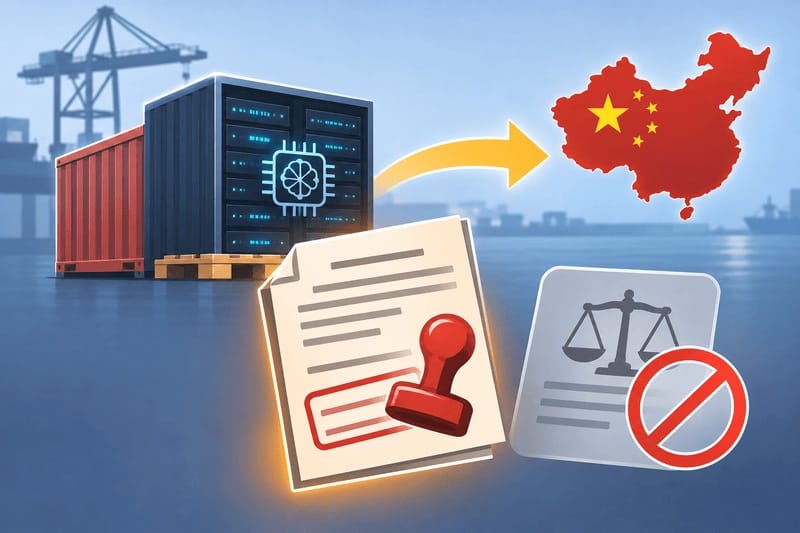
photo by ChatGPT
A legislative proposal introduced in the Legislative Yuan this fall appears designed to close that gap. Bill No. 11022486 (委員提案第 11022486號), introduced by DPP legislators Chong (鍾佳濱) and Chiu (邱志偉), would amend the Foreign Trade Act to add a targeted export licensing regime for high-specification AI and semiconductor products, together with significantly heightened criminal penalties for violations.
Two framing clarifications before the substance.
First, some coverage has characterized this proposal as implementing Taiwan’s obligations under the US-Taiwan bilateral trade framework. That is not accurate. The bilateral trade agreement between the United States and Taiwan has not passed Legislative Yuan review and is not currently in force. These are DPP legislators acting on independent legislative initiative, not pursuant to any treaty obligation.
Second, the bill is at a very early procedural stage. Taiwan’s legislative process runs seven steps: 提案 (bill introduction), 程序委員會 (Procedure Committee scheduling), 第一讀會 (First Reading and committee referral), 委員會審查 (Committee Review, including public hearings), 第二讀會 (Second Reading, article-by-article floor debate), 第三讀會 (Third Reading and final vote), and 總統公布生效 (Presidential promulgation).[1] As of this writing, the bill has completed steps one through three and had its first committee public hearing on November 2, 2026.[2] It has not completed committee review, has not been scheduled for Second Reading, and has no guaranteed passage timeline. The DPP may face coalition resistance. What follows is an analysis of a legislative proposal, not enacted or imminent law.
The Bill’s Three Operative Components
Article 13-2 — Export Licensing for High-Specification Products
The bill would add a new Art. 13-2 authorizing MOEA to designate categories of high-specification AI computing hardware and semiconductor products as requiring export licenses for shipment to China, and specific countries, regions, legal persons, organizations, or other entities and individuals that are subject to substantial control or direction by China, or that engage in circumvention activities for the benefit of China. The licensing obligation would operate independently of the existing Wassenaar-derived dual-use commodity control list and would be triggered by product specifications — processing power, memory bandwidth, interconnect density — rather than by any multilateral technical classification. China is treated differently from other countries, it is subject to Art. 13-2 but not added to the restricted destination list.
This is the structural fix the Keelung prosecution lacked. Under the current framework, enforcement depends on whether the product fits a Wassenaar-derived category. Assembled AI servers often do not, leaving prosecutors reliant on forgery charges when documentation was manipulated. Art. 13-2 would authorize MOEA to designate the product category directly, creating a standalone licensing obligation that can be violated without any falsification of documents.
Article 27 — Amended Base Penalties
Art. 27 currently provides criminal penalties for export control violations of shipping to restricted destinations, with a maximum fine of NT$3 million and 5 years imprisonment. The bill would increase the ceiling to NT$5 million and 10 years imprisonment. Note that this does not involve China, since the bill does not propose to include it in the restricted destinations.
Article 27-3 — New Aggravated Penalty Tier
The bill’s most consequential change is a new Art. 27-3 establishing an aggravated offense tier for export control violations for violating Article 13-2. The same shall apply to any person who, through transshipment, resale, or other circuitous means via a third region, ultimately exports to China specific integrated circuits, critical semiconductor wafer materials, components, or manufacturing equipment.
Any person convicted such offenses would be subject to confiscation of the specific integrated circuits, critical semiconductor wafer materials, components, and manufacturing equipment exported without authorization, as well as any property or proprietary benefits obtained through the commission of the offense, to strip potential perpetrators of financial incentives.
The legislative rationale states a sentencing range of three to ten years’ imprisonment and a mandatory fine of NT$5 million to NT$10 million. However, the proposed statutory text of Art. 27-3 uses the phrase “十年以下” — up to ten years — without a mandatory floor. If enacted in its current form, the minimum stated in the rationale would not appear in the operative statute, leaving the floor to judicial discretion or general sentencing principles rather than mandatory minimum operation.
This gap is worth flagging precisely because mandatory minimums, when they exist, constrain prosecutorial plea leverage and sentencing predictability. Whether the floor survives to final passage depends on committee review. It would typically be corrected as a technical drafting matter during clause-by-clause review (逐條審查); practitioners should not assume the rationale-stated floor will be in the enrolled bill.
The List Problem
The bill’s enforcement architecture depends entirely on MOEA publishing a controlled goods list under Art. 13-2. Without that list, there is no license requirement and no Art. 27-3 exposure. The bill as drafted delegates this function to MOEA and sets no publication deadline, no minimum specification threshold, and no legislative criteria constraining MOEA’s designation authority.
Broad ministerial delegation is standard in Taiwanese regulatory drafting and does not make the provision unusual. But it means the operative compliance implications cannot be determined from the statute alone. The practical trigger for a company assessing exposure is not the law’s effective date — it is MOEA’s post-enactment list publication. Companies will need to monitor MOEA rulemaking, not just the legislative calendar.
Anti-Circumvention and Third-Country Routing
The bill includes an anti-circumvention clause that expressly covers transshipment through third-country intermediaries as a violation of the licensing obligation.
For foreign companies with Taiwan-based operations, this clause has implications beyond the direct export transaction. Under the bill as proposed, a Taiwan-incorporated entity that ships Art. 13-2-designated products to an intermediary in Singapore or Malaysia with knowledge that the ultimate destination is a controlled jurisdiction would be within the scope of the criminal provision. The transshipment step does not break liability. Supply chain compliance programs calibrated to the current Art. 27 — which focuses on the direct exporting party — may not capture the full exposure as proposed.
Enforcement Architecture After Keelung
The Keelung prosecution resulted in forgery charges because that was the tool available. The bill as proposed would give Taiwan prosecutors a clean AI-hardware-specific charge without the Wassenaar characterization problem. Whether that becomes routine enforcement practice depends on two downstream variables: how broadly MOEA defines the controlled goods list, and how aggressively prosecutors choose to use an aggravated penalty tier with potential sentences of three to ten years.
For companies that have been treating Taiwan export control compliance as lower-stakes than US BIS or OFAC exposure, the aggravated tier — if enacted at the rationale-stated severity — would materially change that calculus. The fine range of NT$5-10 million combined with multi-year imprisonment for aggravated violations brings Taiwan’s potential criminal exposure closer to the enforcement severity companies already factor in for US sanctions.
What to Watch
The bill is in committee. Several things could change before it reaches a floor vote, if it does: the Art. 27-3 drafting floor ambiguity, the scope of the anti-circumvention provision, and the breadth of MOEA’s delegation under Art. 13-2 are all candidates for amendment. Party negotiations in the Legislative Yuan add additional uncertainty.
The compliance trigger, if the bill is enacted, is MOEA’s controlled goods list — not the law’s effective date. Companies with Taiwan semiconductor or AI hardware supply chains should build monitoring of that rulemaking into their compliance calendar now, so they are not reacting after the list is published.
